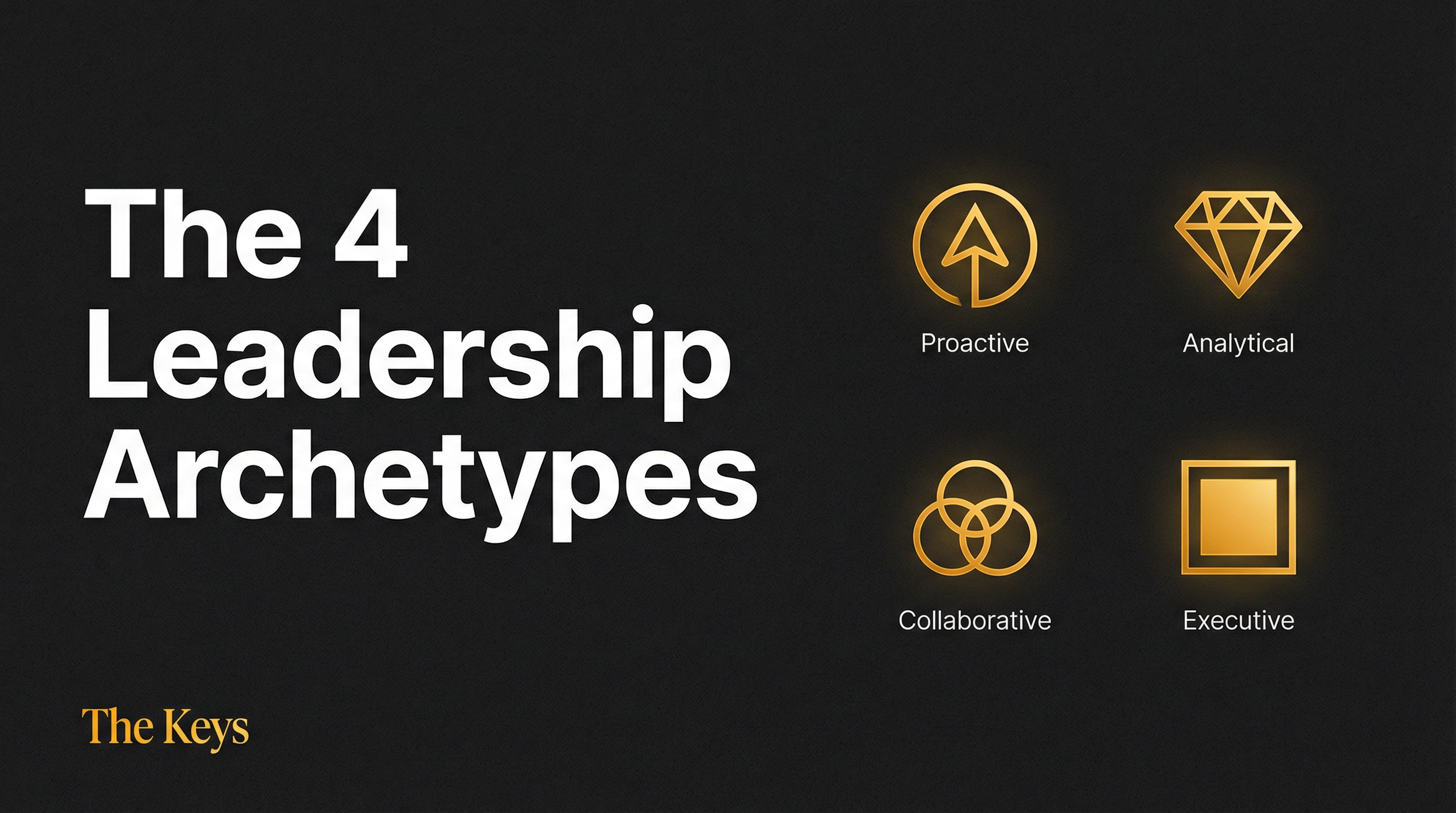
The 4 Leadership Archetypes — And How Each One Breaks Under Stress
I have a question for you. And I want you to answer it honestly, because the honest answer is more useful than the aspirational one.
When things get hard — really hard, not just inconvenient — what do you do?
Not what you think you should do. Not what you would tell someone else to do. What do you actually do? Where does your instinct take you?
Most people, when they sit with that question long enough, can identify a pattern. They speed up, or they slow down. They pull people closer, or they pull back and go it alone. They get louder, or they go quiet. The pattern is consistent, and it shows up most clearly when the pressure is highest.
That pattern is your archetype. And understanding it is the foundation of everything we do inside the PACE x STRAIN framework.
Why Archetypes Matter More Than Personality Types
I want to be clear about something before we go further. This is not a personality test. I am not here to tell you whether you are an introvert or an extrovert, or whether you lead with your head or your heart, or what your four-letter code says about your communication preferences.
Those tools have their place. But they describe who you are. The PACE framework is built to describe how you perform. Specifically, how you create value when conditions are stable, and how that value-creation pattern predictably shifts when conditions are not.
That distinction matters enormously in practice. Knowing that you are a "Driver" or a "High D" or whatever the current terminology is does not tell you what is going to happen to your leadership when you are six months into a difficult turnaround and your best people are burning out. Knowing your PACE archetype does.
There are four of them. Here is what each one looks like at its best, and what it looks like when the pressure has been on too long.
The Proactive Leader
The Proactive leader is the one who moves. They see an opportunity or a problem and they are already in motion before others have finished processing the situation. They set pace. They create momentum. They are energizing to be around when things are going well, because their forward motion is contagious.
This is a genuine superpower. Organizations need people who can initiate, who do not wait for permission, who treat inertia as the enemy. The Proactive leader is often the reason a team or a company gets off the ground at all.
Here is where it gets complicated. Under sustained pressure, the pace accelerates. Decisions happen faster. Communication gets shorter. The leader is moving so quickly that the team cannot keep up, and the leader does not notice because they are focused on what is ahead, not on whether anyone is still behind them. People start executing in different directions because they were not given the clarity to execute in the same one. The strength is still there. It is just running at a speed that the situation cannot absorb.
If you recognize yourself here, the strain pattern to watch for is acceleration that outpaces the people around you. The trade is not slowing down. It is learning to recognize when your speed has stopped serving the outcome and making a deliberate choice to pause and bring the team along.
The Analytical Leader
The Analytical leader is the one who gets it right. They reduce uncertainty. They ask the questions nobody else thought to ask. They evaluate options with a rigor that produces decisions that hold up over time. When you need to make a high-stakes call and you want someone in the room who has actually thought it through, this is your person.
The value here is real. Precision matters. Careful evaluation matters. The Analytical leader saves organizations from costly mistakes by refusing to move before the picture is clear.
Under pressure, the picture never quite gets clear enough. There is always one more variable to consider, one more scenario to model, one more piece of data that would make the decision feel more certain. The team is waiting. The window is closing. And the leader is still in evaluation mode, because certainty is what has always made their decisions good. The strength has not disappeared. It has become a bottleneck.
If this is you, the strain pattern to watch for is analysis that tips into delay. The trade is not becoming reckless. It is learning to recognize when additional information has stopped reducing risk and started just reducing discomfort.
The Collaborative Leader
The Collaborative leader is the one who brings people together. They build trust. They create environments where people feel genuinely valued and heard. They make decisions that people are committed to rather than merely compliant with. Teams led by Collaborative leaders tend to be unusually cohesive, and that cohesion produces results that other teams cannot replicate.
This is not soft stuff. The ability to build real trust and alignment is one of the rarest and most valuable things a leader can do. Organizations that have it outperform those that do not, consistently.
Under pressure, the hard calls get deferred. A conversation that needs to happen does not happen, because the relationship feels too important to risk. A decision that would create conflict gets delayed, because the team's harmony feels more fragile than it actually is. The leader is protecting something real. They are just protecting it at the cost of the outcomes the team was assembled to produce. The strength has become avoidance.
If this is you, the strain pattern to watch for is harmony preservation that crosses into conflict avoidance. The trade is not becoming hard. It is learning to recognize when protecting the relationship means having the conversation, not avoiding it.
The Executive Leader
The Executive leader is the one who drives. They set standards. They make decisions with authority and clarity. They create organizations that move with purpose and hold themselves to high expectations. When you need someone to take ownership of an outcome and actually deliver it, this is who you want.
The value here is straightforward. Direction matters. Accountability matters. The Executive leader creates clarity in environments where ambiguity would otherwise slow everything down.
Under pressure, the grip tightens. Delegation contracts. Every significant decision routes back through the leader, because the stakes feel too high to trust anyone else with them. The team's initiative atrophies. People stop bringing problems forward because they expect to be overruled or corrected. The leader is working harder than ever, and the organization is becoming less capable by the week. The strength has become rigidity.
If this is you, the strain pattern to watch for is control that contracts under pressure. The trade is not letting go of standards. It is learning to recognize when holding on tighter is producing the opposite of what you intend.
One More Thing
Every one of these archetypes is a genuine asset. There is no bad archetype. There is no profile that is better suited to leadership than the others. Each one creates real value, and each one has a specific way it creates problems when the conditions are right.
The goal is not to change your archetype. You cannot, and you would not want to. The goal is to understand it well enough that you can recognize when your strength is working for you and when it has crossed the line into working against you.
That recognition is a skill. It can be developed. And it starts with knowing your profile.
The PACE RESET is a 15-day program that walks you through the PACE archetype assessment and the STRAIN channel assessment. It is the starting point for understanding your specific pattern and what to do with it.